Shen Minjuan
Ambassador Extraordinary and Plenipotentiary of the People’s Republic of China to Mongolia
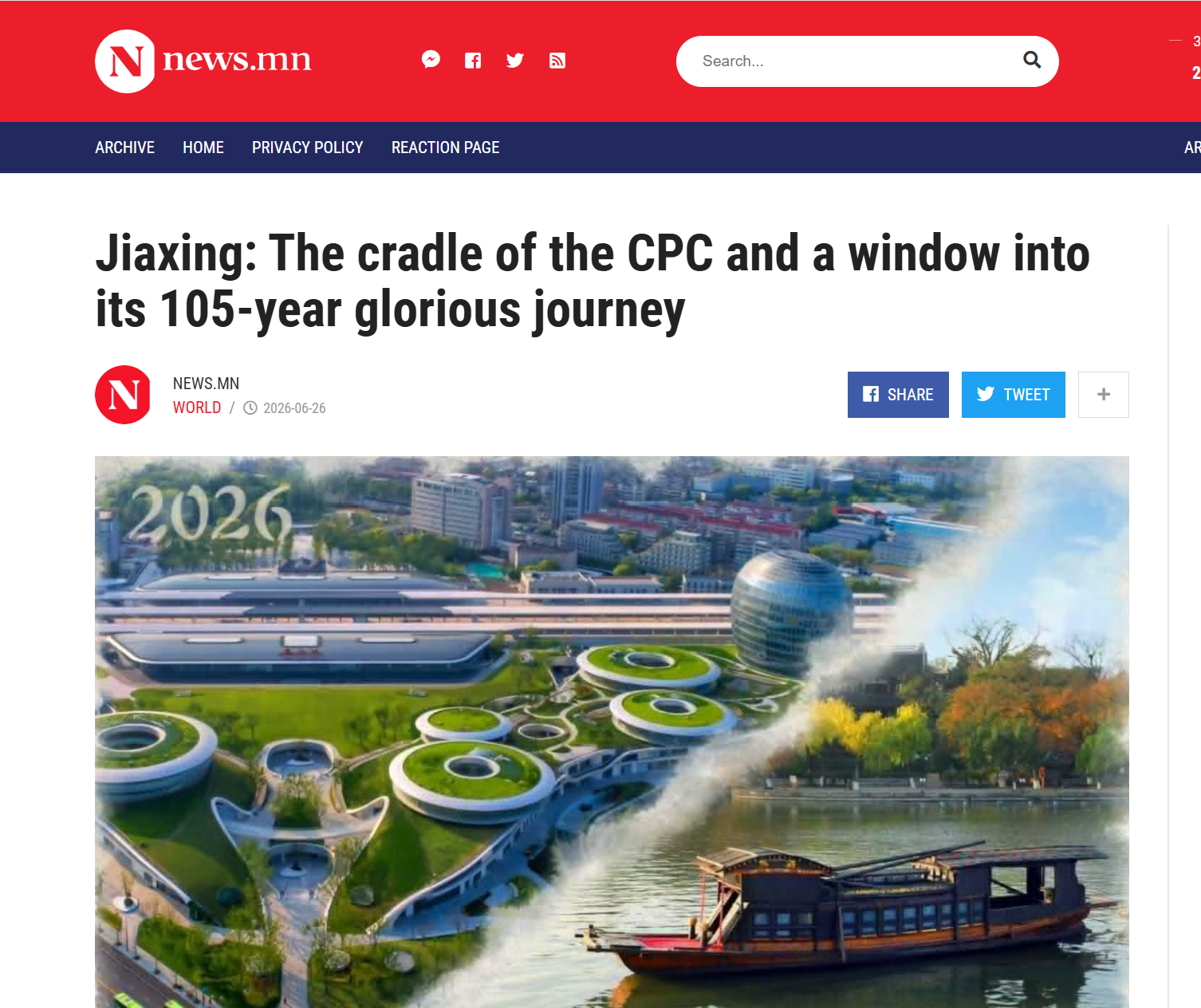
In July 1921, 105 years ago, an intense meeting was underway aboard a boat on Nanhu Lake in Jiaxing, Zhejiang Province. Following the discussions, the delegates unanimously adopted two epoch-making documents: the First Program of the Communist Party of China and the First Resolution of the Communist Party of China. With those, the Communist Party of China (CPC) was born.
In October 2017, just one week after the conclusion of the 19th CPC National Congress, General Secretary Xi Jinping led members of the newly elected Standing Committee of the Political Bureau to the Nanhu Lake to pay tribute to this particular red boat. As the ancient Chinese adage goes, a promising cause may seem simple at the beginning, yet proves great on completion. It was from the very boat that the Party’s century-long journey of leading national independence, people’s liberation, and national prosperity set sail.
In March 1938, outside Wuzhen in Jiaxing, a counter-Japanese guerrilla unit laid an ambush and launched a surprise attack on seven passing Japanese motorboats, wiping out nearly 100 enemy troops. Supported by the CPC Zhejiang Provisional Provincial Committee, this force opened up vast guerrilla battlefields and mobilized a large number of patriots to join the resistance, making significant contributions to the resistance against Japanese aggression in northern Zhejiang. At this critical juncture of national survival, the Party took the lead in raising the banner of armed resistance, adhered to the correct path of total resistance, and led the Chinese people to the great victory of the War of Resistance Against Japanese Aggression.
In March 1955, at the Xincang Production Cooperative in Jiaxing, a pilot team from the supply and marketing cooperative delivered a momentous contract, which set goals for production, guaranteed marketing, and led to a substantial boost in efficiency. Chairman Mao Zedong highly commended the practice, noting in an official instruction that it “should be widely promoted”, which allowed the “Xincang Experience” spread across the country. Following the founding of the People’s Republic of China, the Party led the people in carrying out socialist transformation and development creatively, laying a solid foundation for all of China’s subsequent development and progress.
In June 1981, Bu Xinsheng, head of the Haiyan Shirt Factory in Jiaxing, announced a groundbreaking change: the factory is no longer state-owned; wages would be paid by piecework and any defective would be compensated. This move ignited unprecedented enthusiasm among workers. Within two years, the profits of the shirt factory, which had been on the brink of bankruptcy, increased over 100-fold. The CPC Central Committee hailed this experience as “a good medicine”, unveiling a nationwide enterprise reform. By combining top-level design with the practice of “crossing the river by feeling the stones”, the Party led the people in blazing a path of socialism with Chinese characteristics, enabling China to catch up with the times in giant strides.
In March 2004, on the urban-rural Bus No. 101 in Jiaxing, Xi Jinping, then Secretary of the CPC Zhejiang Provincial Committee, asked passengers for their suggestions on urban-rural public transport integration. Subsequently, Comrade Xi Jinping made two major strategic decisions: the Green Rural Revival Program and the Double-Eight Strategy, drawing up a blueprint for Zhejiang’s development, particularly its urban-rural integration, and designating Jiaxing as a “pilot zone for urban-rural integration”. Today, the income gap between urban and rural residents in Jiaxing has narrowed to a provincial leading ratio of 1.48:1. The Party has always put the people first by working to build a moderately prosperous society in all respects, eradicating absolute poverty, and marching steadily toward the goal of common prosperity for the people.
In August 2025, at the Yangtze River Delta Region Institute of Tsinghua University, Zhejiang, based in Jiaxing, Academician Jiang Kaichun’s team was developing of a micro-turbine engine. This technology enables unmanned aerial vehicles (UAVs) to fly for nearly 30 hours with a payload of 200 kg, providing greater empowerment for people’s work and daily lives. This is a vivid practice of Jiaxing’s innovation-driven development and a reflection of China’s high-quality development. In different eras, the Party has always moved with the times, upheld fundamental principles and broken new ground, leading the people to pave a new path of Chinese modernization and create a new form of human advancement.
Earlier this month, diplomats and representatives of business chambers and associations from 20 countries gathered in Jiaxing. They wandered through the Xiangfudang Sci-tech Innovation Green Valley to learn about green, integrated ecological development, toured the Innovation Center of Yangtze River Delta of Zhejiang University to get to know about new models of university-industry-research collaboration, and visited the Jiaxing Opening-up Service Center to experience the convenience of its one-stop services. Not long ago, the Jiaxing Nanhu Airport put into operation and opened two international cargo routes, which further improves the international cargo network in the Yangtze River Delta. This represents Jiaxing’s concrete steps to support the high-quality Belt and Road cooperation and serves as an example of China’s continuous expansion of high-standard opening up.
As the saying goes, “If you want to go fast, go alone; if you want to go far, go together”. The small red boat that set sail from Nanhu Lake in Jiaxing has long grown into a giant ship steering China forward and has been committed to partnering and sailing together with all other countries in the tide of development for a brighter future for the human society.