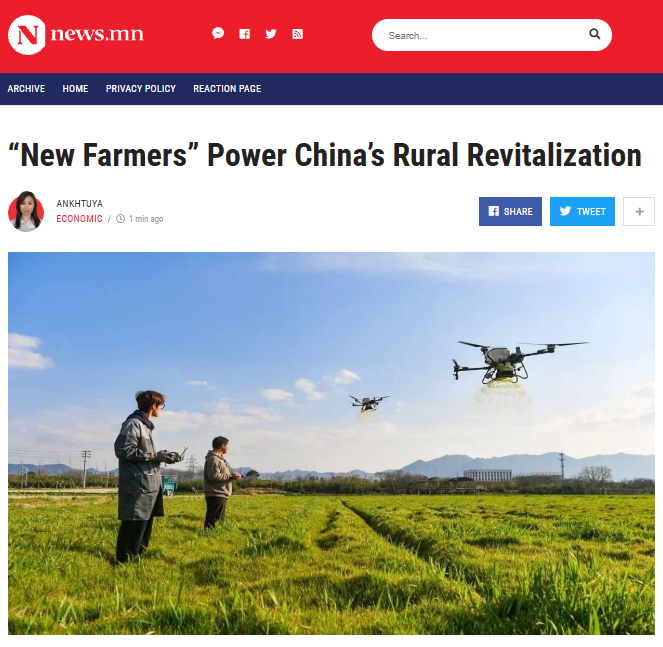
In recent years, China’s “new farmers” have gone viral, who are the next-generation agricultural workers that are well-educated, tech-savvy and skilled in business management. Instead of hoes and sickles, they carry drones, smartphones and data analytic systems.
In the first half of this year, China’s rural residents had a per capita disposable income of RMB 12,699 (USD 1,875), up 6.4% year on year, continuing to outpace the growth of urban residents’ incomes. The ratio of urban to rural per capita disposable income fell to 2.37, down 0.05 from a year earlier. These figures are achieved because of the modern technologies, market-oriented mentality, and management expertise that millions of new farmers have brought to the countryside. As China’s rural revitalization strategy advances, these new farmers are channeling capital, talent and data into the fields, creating abundant employment opportunities and becoming an important force for more balanced urban-rural development.
So, what makes China’s countryside so attractive to talented people seeking to become new farmers?
First, national strategies give new farmers ample room to thrive. In 2026, China called for “developing and strengthening the rural talent pool and encouraging people to serve, start businesses and find employment in rural areas”. For the first time, it explicitly called for “fostering agricultural entrepreneurs in light of local conditions”, marking the formal inclusion of new farmers in China’s national talent strategy. The Plan on All-Around Rural Revitalization for the 2024-2027 period aims to encourage young people to develop their careers in rural areas and establish a system for professionals to serve in the countryside regularly. This places new farmers within the long-term framework for all-around rural revitalization. To address the three most immediate barriers—capital, land and administrative procedures—China has rolled out a package of measures, including start-up subsidies, interest subsidies on loans, and streamlined procedures for land transfers and project approvals. These measures make entrepreneurship more viable and financing more accessible, giving new farmers the confidence to innovate and devote themselves to their work.
Second, upgraded infrastructure now fully equips new farmers. In the past, many rural areas in China suffered inadequate transportation and limited access to information. Agricultural products from remote mountainous areas could not reach markets, while farmers’ production were often misaligned with market demand. Today, with a strong commitment to infrastructure development, China has achieved gigabit broadband coverage and 5G connectivity in every county, and broadband access now covers all administrative villages. These advances have broken down information barriers between urban and rural areas. With a smartphone, today’s new farmers can show their tea garden on the green hillsides. The internet of things sensors help fine-tune light, temperature, humidity, and air conditions in greenhouses. Cold-chain logistics and e-commerce platforms can ship fresh fruit picked in the morning to dinner tables thousands of kilometers away the next day. The widespread adoption of digital infrastructure has not only transformed the face of the countryside but also given new farmers a practical way to put their ideas into action.
Third, a well-developed training mechanism opens up space for new farmers to grow. China has established a complete system covering selection, recruitment, training and placement. Local governments have introduced a range of preferential policies to attract university graduates to provide teaching, agricultural and medical services in rural areas and support rural development. By the end of last year, more than 15.1 million people had returned to their hometowns to start businesses. Local governments have pooled resources from agricultural colleges and businesses to provide training programs, forming a team of over 400,000 agricultural researchers and over 9 million skilled farmers nationwide. By providing business incubators and service platforms for rural entrepreneurship, local governments are helping entrepreneurs in the countryside secure financing and markets to multiply the benefits in employment and income growth. In addition, an improving evaluation system help rural talent gain wider social recognition and climb the career ladder, enabling professionals to settle down with confidence. Thanks to this comprehensive system, new farmers are no longer individual success stories but a growing force.
Mongolia is a traditional powerhouse in animal husbandry. The country is also implementing a series of initiatives, including “Food Supply and Security” and the “Atar-4” campaign, to support agricultural production. Farmland, pastureland and livestock are closely tied to the livelihoods of more than 30% of the national population.
This year marks the fifth anniversary of President Xi Jinping’s proposal of the Global Development Initiative (GDI). Over the past five years, China has remained committed to training local agricultural and animal husbandry professionals for Mongolia. The two sides have also engaged in in-depth cooperation in areas such as combating desertification, improving soil quality and preventing and controlling animal diseases, helping Mongolia strengthen its resilience to risks and improve the sustainability of its development. All of these are examples of the fruitful results achieved by China and Mongolia in implementing the GDI.
Poverty reduction and rural revitalization are important areas of cooperation under the GDI. China stands ready to continue sharing its development practices with Mongolia, strengthen capacity building and support more “new herders” in Mongolia in putting their skills to full use on the grasslands, helping China-Mongolia mutually beneficial cooperation bear even more fruit through shared development.